
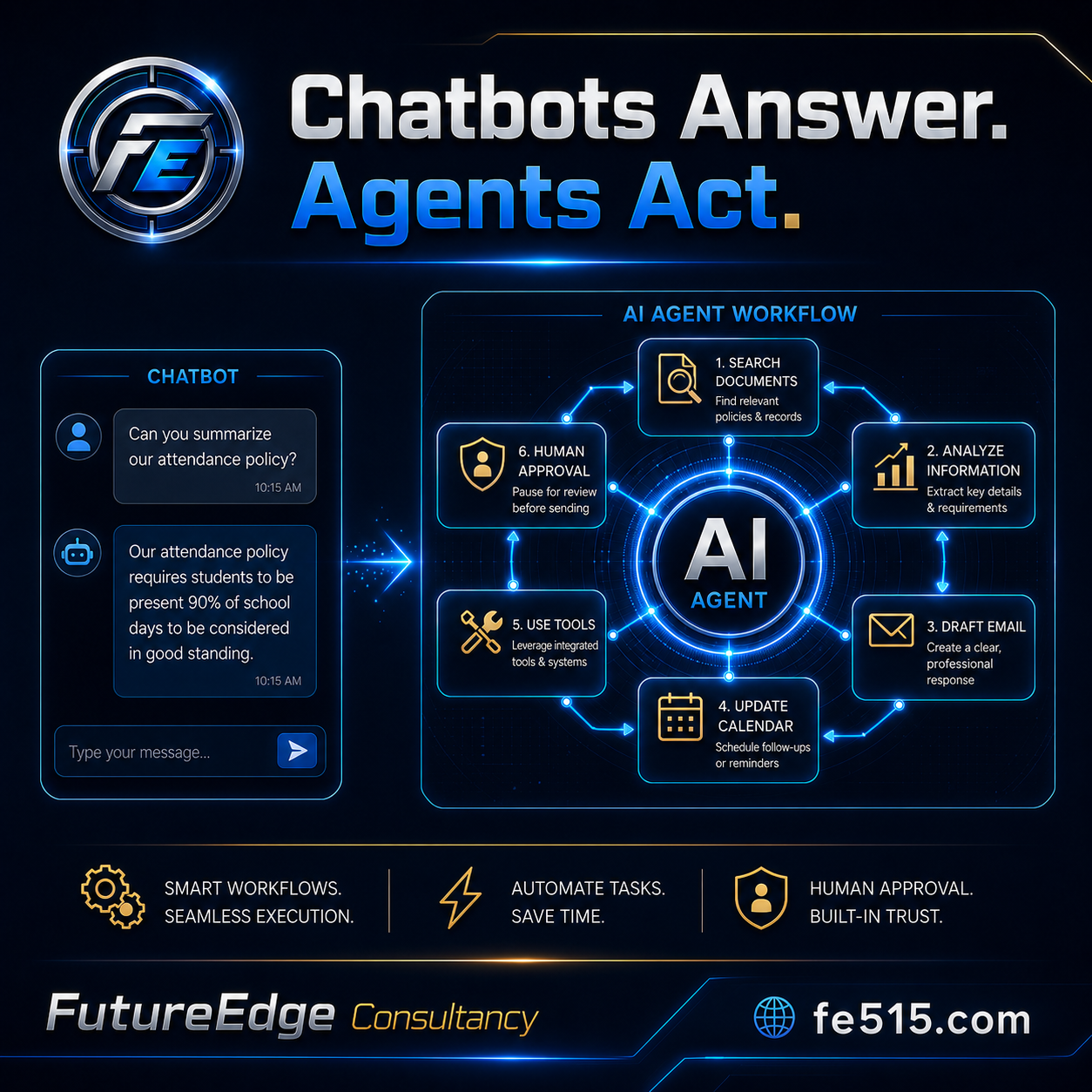
An AI agent is an AI system that can carry out a multi-step task, not just answer a question. It can look up information, use the tools you approve, draft documents and messages, and stop to ask a person before anything important happens.
That last part is what separates a useful agent from a risky one. This guide explains what an agent actually does, using an example from a school office, and where human approval belongs.
Already convinced and wondering where to start? Read AI Agents Are Moving Beyond Chatbots: What Should You Automate First?
In short: a chatbot gives you information. An AI agent helps you complete the work.
What does an AI agent actually do?
Imagine a school administrator needs to respond to a complicated attendance situation.
A basic chatbot might summarize the district’s attendance policy. An AI agent could go further by:
Searching the district’s current policies and handbook.
Identifying the sections related to the situation.
Asking the administrator for missing details.
Reviewing previous documentation.
Drafting a parent communication.
Creating a follow-up reminder.
Preparing a summary for administrative review.
Pausing before any message is sent.
A business could use a similar process for customer service, employee onboarding, contract review, invoice follow-up, or sales outreach.
The agent is not simply creating text. It is coordinating a workflow.
Why does this matter for schools and businesses?
Most organizations do not struggle because they lack information. They struggle because their information is scattered across documents, email, calendars, databases, and different software platforms.
Employees spend significant time moving information between those systems.
An AI agent can help connect the steps. It can reduce repetitive work while still keeping people in control of important decisions.
This is especially valuable for smaller departments where a few employees are responsible for a large number of tasks.
A well-designed agent can help an organization:
Reduce repetitive administrative work
Respond more consistently
Find information faster
Create better documentation
Track follow-up responsibilities
Improve communication
Maintain an audit trail
Human approval still matters
An agent should not be given unlimited authority.
Schools and businesses must decide what the AI can read, draft, recommend, change, or send. High-impact actions should require human approval.
For example, an AI agent might be allowed to draft a parent email, but an administrator should review it before it is sent. It might prepare an invoice, but a finance employee should approve the amount. It might recommend a disciplinary process, but the school leader remains responsible for the decision.
The strongest systems combine AI efficiency with professional judgment.
A practical starting point
Organizations should begin with one clearly defined workflow.
Choose a process that:
Happens frequently
Includes several repeatable steps
Requires information from multiple sources
Takes employees a meaningful amount of time
Can be reviewed before final action
Do not begin by trying to automate an entire organization. Start with one process, measure the results, and improve it carefully.
AI agents will not replace the need for leadership, expertise, or accountability. They can, however, help capable people spend less time on repetitive processes and more time on decisions that require human experience.
FutureEdge Consultancy helps schools and businesses explore practical AI systems built around real organizational needs.
Learn more at fe515.com.
