
RAG: How AI Can Answer Using Your Trusted Information
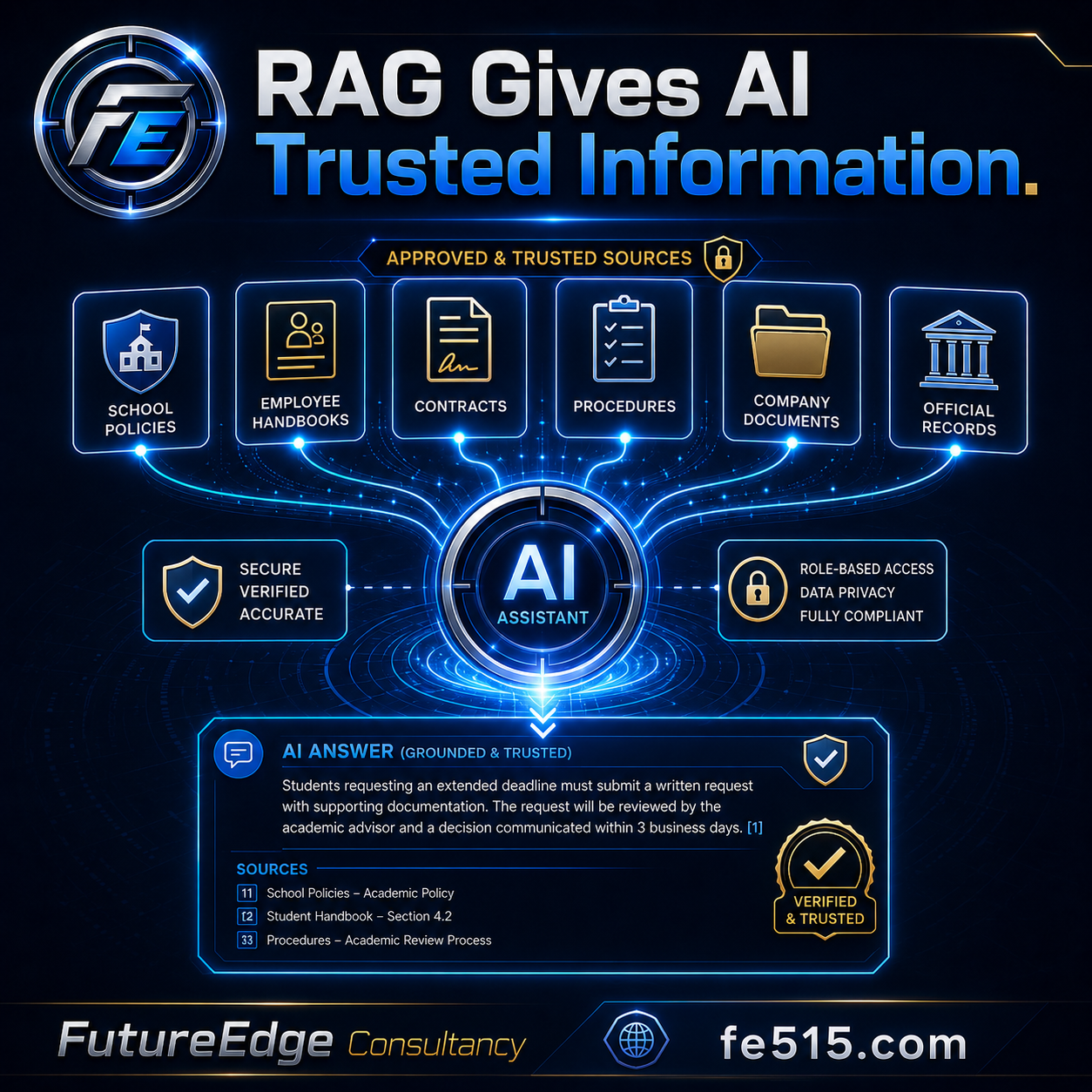
One of the biggest concerns about artificial intelligence is whether its answers can be trusted.
AI models are trained on enormous amounts of information, but they do not automatically know your organization’s current policies, procedures, contracts, employee handbook, or internal records.
That is where RAG becomes important.
RAG stands for retrieval-augmented generation. The term sounds technical, but the idea is straightforward:
Before the AI answers, it searches your approved information and uses the most relevant material to create its response.
Think of it as giving AI an open-book test using the documents your organization has selected.
Why ordinary AI answers are not always enough
A general AI model may be able to explain common school policies or standard business practices. However, it may not know:
Your district’s board policies
Your student handbook
Your employee procedures
Your negotiated agreements
Your company’s pricing rules
Your current contracts
Your internal approval process
Your most recent forms and documents
Without access to the right information, the AI may provide a general answer that sounds reasonable but does not match your organization.
RAG helps solve that problem by grounding the response in trusted sources.
How RAG works
A RAG system usually follows three basic steps.
First, it searches the organization’s approved documents for information related to the question.
Second, it selects the sections that appear most relevant.
Third, it gives those sections to the AI model so the answer can be based on the retrieved information.
A strong RAG system can also provide citations, document names, page references, and links to the original source.
For example, a principal might ask:
“What steps does our district require before assigning a long-term suspension?”
Instead of relying only on general knowledge, the AI could search the district’s board policies, student handbook, and administrative procedures. It could then provide a response showing the required steps and cite the sections that support the answer.
How businesses can use RAG
Businesses can use the same approach for questions involving:
Employee policies
Customer contracts
Product information
Safety procedures
Pricing guidelines
Standard operating procedures
Previous proposals
Training materials
Compliance requirements
A salesperson could ask whether a particular discount is allowed. An HR employee could find the correct leave procedure. A manager could review contract renewal requirements. A support representative could locate the approved answer to a customer’s technical question.
Not every RAG system is production-ready
Uploading several PDFs to a chatbot may produce an interesting demonstration, but that does not automatically create a dependable organizational system.
A production-quality RAG system also needs:
Accurate document extraction
Clear document organization
Version control
Permission-based access
Reliable search
Source citations
Evaluation testing
Privacy protections
A process for updating outdated information
The ability to say when evidence is insufficient
The goal is not to force the AI to answer every question. The goal is to help it provide supported answers and clearly identify when human review is needed.
A foundation for trustworthy AI
RAG is one of the most practical ways schools and businesses can begin using AI responsibly. It allows organizations to combine the flexibility of generative AI with the authority of their own information.
The result is not simply a smarter chatbot. It is a searchable organizational knowledge system that can support faster and more consistent decision-making.
FutureEdge Consultancy helps organizations turn policies, procedures, and internal documents into practical AI-supported knowledge tools.
Learn more at fe515.com.
